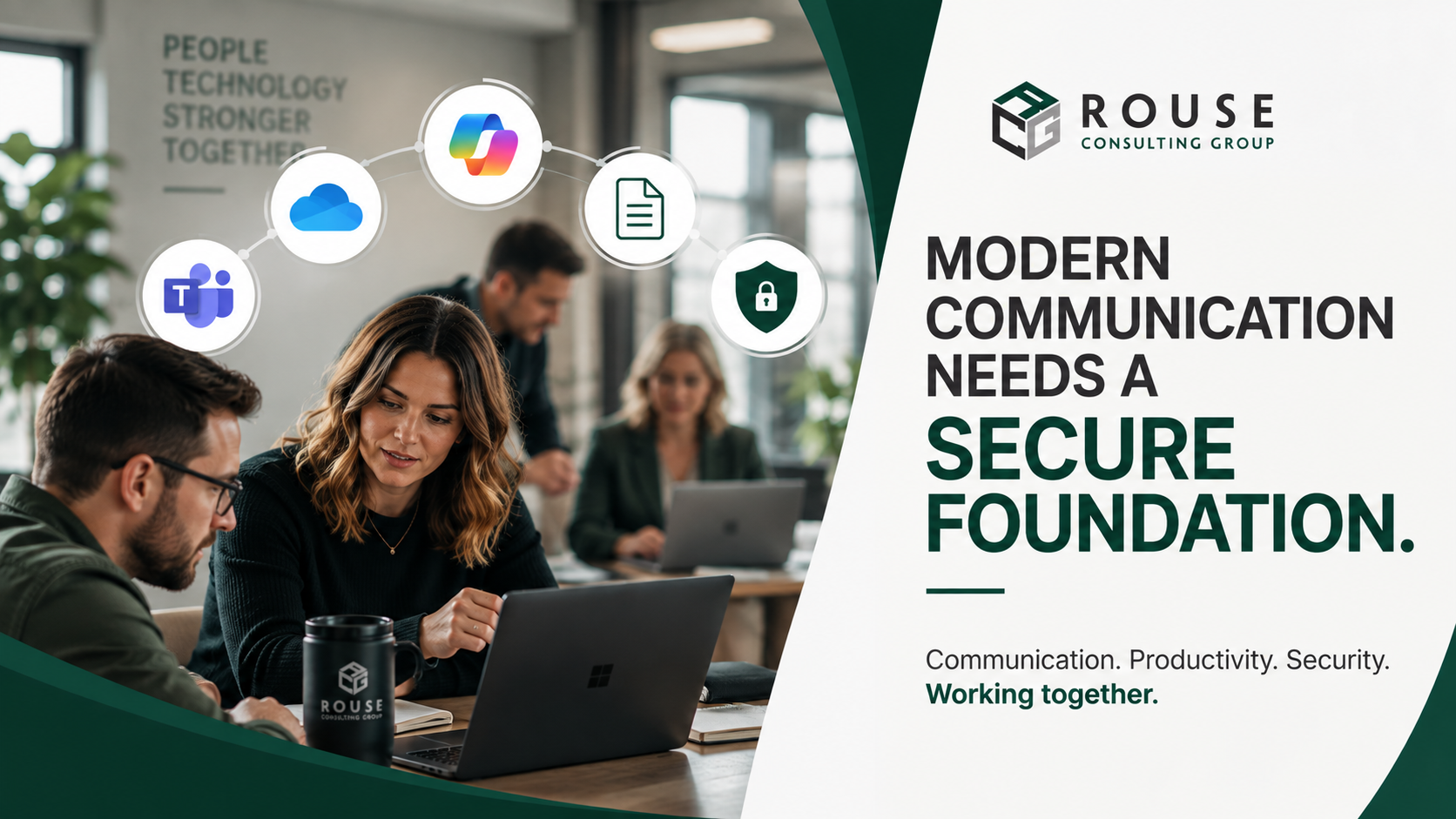
Communication, productivity, and security work better when they’re built on the right technology foundation.
Why Modern Communication Requires a Secure Foundation
The way businesses communicate has changed.
Phone calls and email are still part of the workday, but they are no longer the entire picture. Employees communicate through Microsoft Teams, shared files, video meetings, mobile devices, cloud applications, and increasingly, AI-powered tools like Microsoft Copilot.
All of these tools can make work easier.
But they also mean communication can no longer be treated as a standalone technology decision.
How your team communicates, how productive they can be, and how your business protects its information are all connected.
Communication Is Part of a Bigger Technology Ecosystem
Think about how much business information moves through communication and collaboration tools every day.
Employees discuss customers in Teams. They share documents through Microsoft 365. They access email from their phones. They collaborate on files from different locations. Meetings are recorded, summarized, and shared.
And with AI becoming part of everyday business applications, employees can find, summarize, and interact with information faster than ever.
That creates tremendous opportunities for productivity.
It also makes the technology foundation behind those tools increasingly important.
If access, permissions, devices, data, and security policies aren’t managed properly, the same tools designed to make information easier to access can also make it easier for information to end up somewhere it shouldn’t.
Myth: Communication and Security Are Separate Conversations
For years, businesses often treated communication and cybersecurity as two different technology decisions.
One conversation was about phones, email, meetings, and collaboration.
The other was about firewalls, passwords, backups, and protecting data.
That separation makes less sense in today’s workplace.
Modern communication platforms are connected directly to business data, user identities, devices, cloud applications, and customer information.
Security isn’t something that gets added after a communication platform is selected.
It needs to be part of the environment from the beginning.
AI Makes the Foundation Even More Important
There’s another misconception we hear frequently: AI is mostly about creating content.
That’s certainly one use for it, but tools like Microsoft Copilot are becoming much more integrated into everyday work.
AI can help employees summarize meetings, find information, draft communications, organize tasks, analyze documents, and work across Microsoft 365.
That can save employees a tremendous amount of time.
But AI also reinforces an important principle:
Your technology is only as effective as the environment supporting it.
AI doesn’t eliminate the need for good data management, appropriate permissions, secure access, or clear processes. If anything, it makes those things more important.
Before asking what AI can do with your business information, it’s worth asking whether the right people have access to the right information in the first place.
Growth Doesn’t Have to Mean More Technology
As businesses grow, it’s easy for the technology stack to grow with them.
A new communication tool gets added.
Another application solves a specific problem.
A department creates its own process.
Another platform fills a temporary gap.
Eventually, employees are switching between multiple systems, information lives in different places, and IT becomes harder to manage and secure.
The answer isn’t always another tool.
Sometimes it’s the opposite.
Businesses often benefit more from simplifying their technology environment, integrating the systems they already use, and creating a more consistent experience for employees.
When communication, collaboration, productivity, and security work together, technology becomes easier to use and easier to manage.
What a Strong Technology Foundation Looks Like
There isn’t one technology stack that works for every organization.
But there are a few questions every business should be asking:
- Can employees easily access the information and tools they need?
- Are permissions and access managed appropriately?
- Are communication and collaboration tools integrated rather than creating more silos?
- Can employees work securely from different locations and devices?
- Are security policies consistent across the organization?
- Can the environment scale as the business grows?
- Is your technology making work simpler or adding unnecessary complexity?
Those aren’t just IT questions.
They affect productivity, customer experience, risk, employee experience, and ultimately, the organization’s ability to grow.
Build for Where Your Business Is Going
Technology changes quickly. The fundamentals of a strong technology strategy don’t.
Your systems should help people communicate effectively, protect business information, reduce unnecessary complexity, and support where the organization is headed next.
That’s why conversations about communication shouldn’t stop with phone features or collaboration tools.
The bigger question is whether your entire technology environment is working together to support the business.
Communication, productivity, and security aren’t separate strategies anymore. They’re different parts of the same foundation.
Is Your Technology Working Together?
If your communication tools, Microsoft 365 environment, security strategy, and business systems have evolved independently over the years, it may be time to look at the bigger picture.
Rouse Consulting Group helps businesses build secure, reliable technology environments designed around how their people actually work and where their business is going.
Still rethinking how your team communicates?
Download our free guide, 5 Business Communication Myths That Are Costing Teams Time, to uncover common assumptions that may be creating unnecessary friction in your workplace.